

Brazil 3PL Market to Reach USD 58.4 Billion by 2034, Growing at 7.11% CAGR: Report IMARC Group
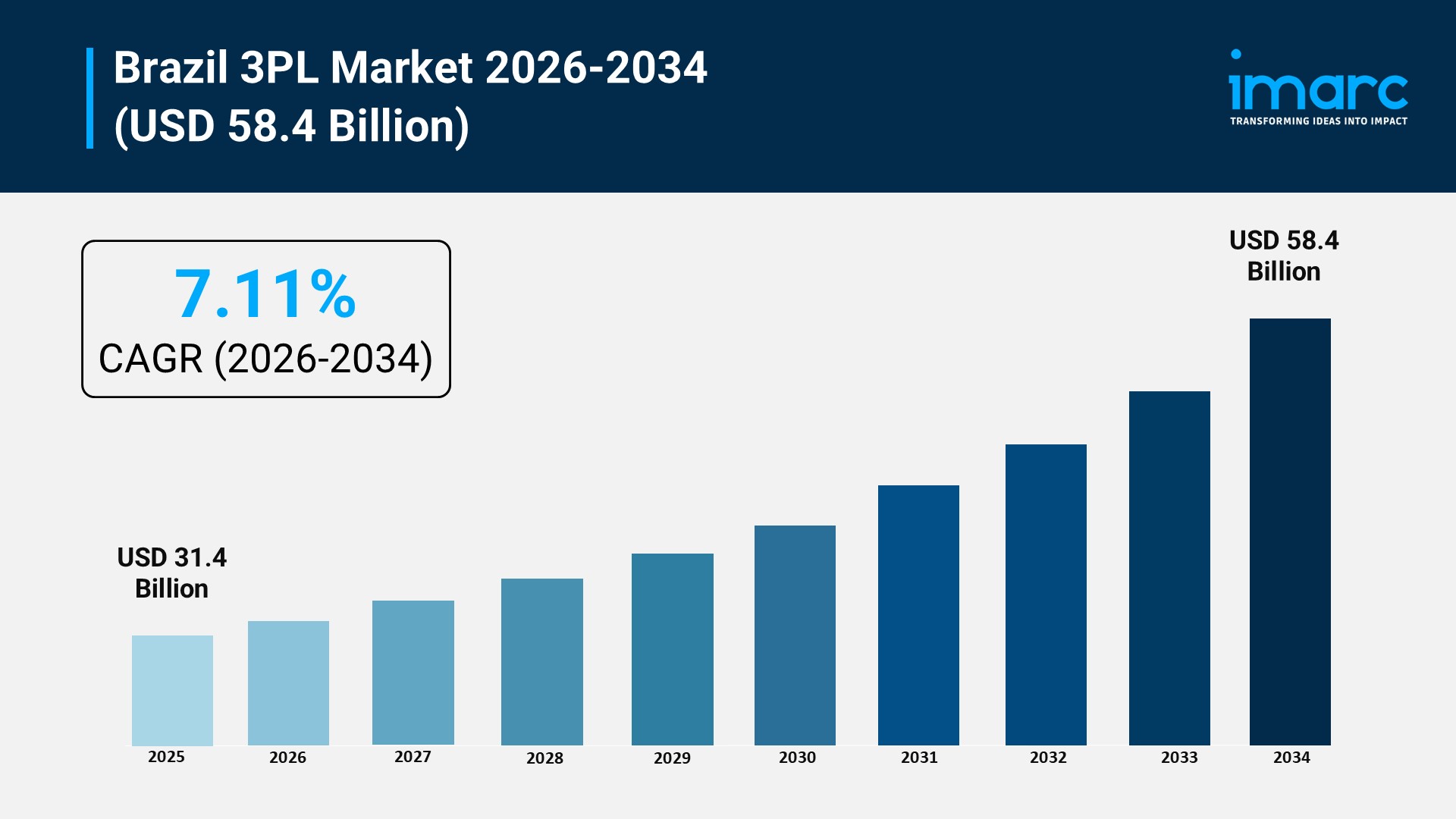
Brazil 3PL Market Graph 2026
IMARC Group's Latest Research Reveals a CAGR of 7.11% from 2026–2034, with Domestic Transportation Management and Consumer & Retail Segments Leading Expansion
SãO PAULO, SãO PAULO, BRAZIL, February 26, 2026 /EINPresswire.com/ -- Brazil's third-party logistics (3PL) market has emerged as one of Latin America's most dynamic growth stories, with its market size valued at USD 31.4 Billion in 2025. Backed by rising domestic consumption, an expanding e-commerce ecosystem, and large-scale infrastructure investment, the market is forecast to reach USD 58.4 Billion by 2034, reflecting a robust CAGR of 7.11% over the 2026–2034 forecast period. This trajectory underscores the accelerating shift by Brazilian businesses toward outsourcing logistics functions to specialized third-party providers in pursuit of operational efficiency and supply chain resilience.Approximately 87% of Brazil's population lives in urban areas, generating strong demand for sophisticated distribution networks. Brazil's agribusiness sector generated USD 164.4 Billion in export revenue in 2024, accounting for 49% of total export value, intensifying the need for integrated supply chain services with national and international reach.
Request for a sample to get detailed understanding about the market: https://www.imarcgroup.com/brazil-3pl-market/requestsample
Key Market Statistics at a Glance
• Market Size (2025): USD 31.4 Billion
• Market Forecast (2034): USD 58.4 Billion
• CAGR (2026–2034): 7.11%
• Historical Period: 2020–2025
• Leading Service Segment: Domestic Transportation Management — 52.3% share
• Leading End User: Consumer and Retail — 27.2% share
• Dominant Region: Southeast
What Is Driving Brazil's 3PL Market?
Infrastructure Development
The Brazilian government and private sector are making transformative investments in logistics infrastructure. In February 2025, the government announced a USD 12 Billion investment in grain harvest logistics, targeting road, rail, and port upgrades along key agricultural corridors. Projects under the Investment Partnerships Program (PPI) have opened avenues for private participation in transport concessions, while port modernization at Santos is improving multimodal capabilities and reducing transit delays for 3PL providers.
E-Commerce Expansion
The rapid proliferation of e-commerce is one of the most powerful catalysts for 3PL demand in Brazil. In the first half of 2024, Brazilian e-commerce sales grew by 18.7%, totaling BRL 160.3 Billion (approximately USD 28.66 Billion), creating urgent need for agile logistics infrastructure. This surge has driven demand for urban warehousing, dark stores, and micro-fulfillment centers that enable same-day and next-day delivery in densely populated metros. The integration of AI-based route planning, automated sorting systems, and real-time tracking tools is further enabling 3PL providers to handle the high-frequency, fragmented shipment volumes characteristic of modern online retail.
Manufacturing Sector Growth
Brazil's manufacturing industry — spanning automotive, electronics, food processing, and chemicals — is generating increasing demand for sophisticated logistics support. The sector grew by 3.2% in 2024, ranking 25th among 82 countries per UNIDO data. As manufacturers adopt lean production models and automation, 3PL providers are stepping in with just-in-time delivery, vendor-managed inventory (VMI), inbound logistics, and returnable packaging management. Government incentives for industrial hubs in the South and Southeast are further reinforcing the need for resilient, specialized logistics networks.
Segment Highlights
By Services: Domestic Transportation Management (52.3%)
Domestic transportation management commands the largest share of the Brazil 3PL market, rooted in the geographic realities of operating across one of the world's largest countries. Brazil's vast terrain demands highly effective movement of goods from interior regions to coastal distribution points, making freight brokerage, carrier management, and route optimization services indispensable. As businesses across retail, manufacturing, and agriculture increasingly outsource these functions, the segment's dominance has become self-reinforcing. The fast expansion of e-commerce has amplified this dynamic further, as consumer expectations for speed require highly coordinated domestic logistics at scale.
By End User: Consumer and Retail (27.2%)
The consumer and retail segment leads all end-user verticals with a 27.2% market share in 2025, sustained by middle-class expansion, rising disposable incomes, and rapid e-commerce penetration across Brazil's urban centers. Retailers and consumer goods companies are outsourcing logistics to tackle complex supply chains, accelerate last-mile delivery, and meet consumer expectations for speed and convenience. 3PL providers deliver inventory management, order fulfillment, packaging, and reverse logistics. Seasonal demand surges during Black Friday and Christmas create acute needs for scalable logistics infrastructure, reinforcing retailers' dependence on experienced third-party partners.
By Region: Southeast Dominates
The Southeast region dominates Brazil's 3PL market by virtue of its unmatched industrial density, population concentration, and infrastructure sophistication. Home to major urban centers including São Paulo and Rio de Janeiro, the Southeast generates a disproportionate share of Brazil's GDP and serves as the country's undisputed economic and logistical nerve center. Access to key highways, major seaports, and rail networks facilitates rapid movement of goods both within the region and to other parts of the country. BTG Pactual's September 2024 acquisition of logistics warehouse assets valued at BRL 1.76 Billion (USD 320 Million) from GLP Partners Group signals the scale of institutional investment flowing into this region's logistics infrastructure.
Connect for detailed segmentation analysis, ask for analyst: https://www.imarcgroup.com/request?type=report&id=15750&flag=C
Key Players
• DHL Supply Chain (Deutsche Post AG)
• A.P. Moller – Maersk Logistics & Services
• BBM Logística SA
• JSL SA
• CEVA Logistics AG
Key Challenges
• Regulatory and Tax Complexity: Brazil's notoriously complex tax and regulatory environment — often referred to as the "Custo Brasil" — presents a significant ongoing challenge for 3PL operators. Navigating multi-layered federal, state, and municipal tax obligations, along with customs compliance requirements for international freight, increases operational costs and administrative burdens.
• Infrastructure Gaps and Regional Disparity: Despite high-profile investments, Brazil's infrastructure remains uneven. The North and parts of the Northeast still face significant bottlenecks stemming from poor road quality, limited rail connectivity, and inadequate port capacity outside the Southeast, constraining consistent national coverage.
• Macroeconomic Volatility: Currency fluctuations, inflationary pressures, and rising fuel and labor costs place sustained pressure on 3PL providers' margins. Companies must balance investment in digital transformation and green logistics against near-term profitability constraints in an environment of economic uncertainty.
Elena Anderson
IMARC Services Private Limited
+1 201-971-6302
email us here
Legal Disclaimer:
EIN Presswire provides this news content "as is" without warranty of any kind. We do not accept any responsibility or liability for the accuracy, content, images, videos, licenses, completeness, legality, or reliability of the information contained in this article. If you have any complaints or copyright issues related to this article, kindly contact the author above.
